


UK Plankton Snapshot
We asked plankton scientists and citizen scientists "What's interesting, unusual, or abundant in you samples at the moment?" and here's what they said!
This thread is continually updated, with the latest entries at the top. If you’ve sampled plankton recently and want to tell us about it, use this form.
West Wales, 2 October 2026
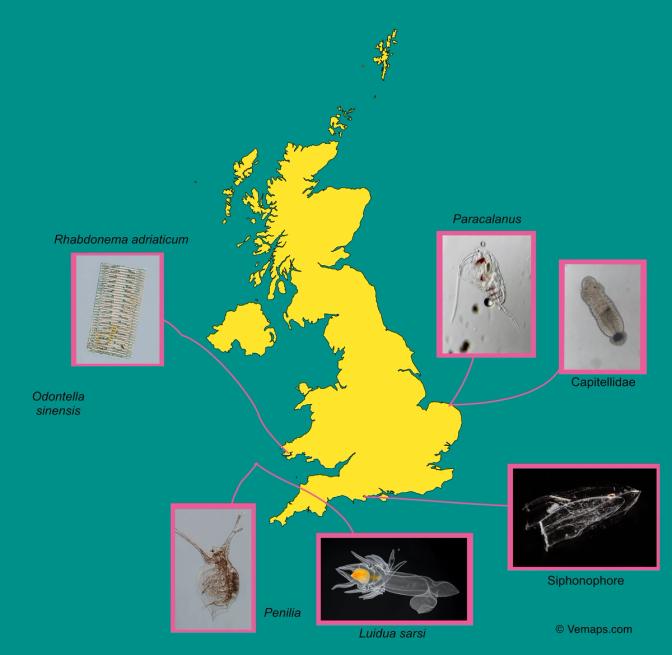
There were alot of diatoms from the species Rhabdonema adriaticum in the sample, which is unusual for this location, especially in this concentration. Read more on Julian Cremona’s blog
Dorset, 2 October 2026
Lots of copepods and gastropod larvae in this sample, along with crab larvae and arrow worms. A particular treat was observing a few siphonophores (phylum Cnidaria). Follow Steve Trewhella on Instagram.
North Norfolk, 29 September 2026
Lots and lots of zooplankton in this sample, especially copepods, of which there were hundreds. The more numerous copepod genus was Paracalanus, followed by Acartia. The Capitellidae and Spionidae polychaete larvae were in high numbers too. Follow Elizabeth Beston on Instagram.
Dorset, 24 September 2026
An interesting find in a night trap was the larvae of the anemone shrimp (genus Periclimenes). Follow Steve Trewhella on Instagram.
Celtic Deep (Celtic Sea), late September 2026
A large bloom of the water fleas Penilia was observed in samples collected from the open ocean in the Celtic Sea. There have also been large numbers of brachiolaria (larvae) of the starfish Luidia sarsi. Read more on Julian Cremona’s blog
West Wales, September 2026
There has been an increase in the diatom species Odonetlla sinensis and Coscinodiscus wailesii. Dionflagellates have increased, with Tripos horridum dominating. Gyrodinium falcatum, a dinoflagellate species that Julian has not observed in the area before, was seen. The rotifer Synchaeta sp. has once again become a dominant zooplankton this month and towards the end of September there has been a lot of the siphonophore species Muggiaea atlantica. Read more on Julian Cremona’s blog
North Norfolk, 20 September 2026
There are still high numbers of the usual suspects: juvenile copepods, cyclopoida copepods, copepod and cirripedia nauplii, and gastropod larvae. This week saw an increase in tintinnid ciliates. Follow Elizabeth Beston on Instagram.
Lundy Island, September 2026
A sample taken to the South West of Lundy Island revealed many hydrozoa medusae from the genus Obelia, which were releasing sperm whilst being observed under the microscope! There were also high numbers of Podon sp. waterfleas, and the dominant diatoms where Rhizosolenia imbricata and Odontella sinensis. Some interesting finds included larvae from the bristle worm family Chaetopteridae, and a very laterally flat gastropod larva (yet to be identified). Read more on Julian Cremona’s blog
Dorset, mid September 2026
A night trapped showed that there are still lots of arrow worms and crab zoea larvae about, and that the mantis shrimp larvae are almost ready to settle into adulthood. Follow Steve Trewhella on Instagram.
North Norfolk, 14 September 2026
The most abundant zooplankton appeared to be juvenile Calanoida copepods, with still lots of nauplii of both copepods and barnacles about. Copepods from the genus Paracalanus seem to be on the rise. There were also lots of Oikopleura sp. appendicularians (a pelagic tunicate) and sea squirt larvae. An interesting find was the larva of a scale worm. The concentration of diatoms appeared to be quite low. Follow Elizabeth Beston on Instagram.
Dorset, early September 2026
A night sample revealed lots of Mantis shrimp larvae still about, along with plenty of copepods, and crab zoea (including pea and nut crabs). Arrow worms are making an appearance, and a rarely seen pelagic bristle worm from the genus Tomopteris was observed. Follow Steve Trewhella on Instagram.
West Scotland, 9 September 2026
Loch samples were plentiful in autotrophic (photosynthesising) dinoflagellates, with a varied selection of diatoms. There were also other mixotrophic and heterotrophic dinoflagellates present. Zooplankton wise, there were Cnidarian and Ctenophora larvae and a fascinating and bizarre-looking decapod zoea larva from the genus Jaxea. Thanks to Zaineb Henderson for the information.
North Norfolk, 9 September 2026
The Rhizosolenia imbricata bloom has ceased, and phytoplankton in general was a lot more sparse. Young and larval crustaceans were in great numbers, including a single nauplius of the crab hacker barnacle (Sacculina carina), a parasite that takes over crabs for its own survival. There were also several mystery planula larvae, which may be sponge. Follow Elizabeth Beston on Instagram.
West Wales, 3 September 2026
At another sample site in West Wales, there were lots of crab megalopa larvae, which is a later larval stage and comes before settlement on the sea floor. Read more on Julian Cremona’s blog
Dorset, late August 2026
Crab zoea larvae are currently present in samples. Follow Steve Trewhella on Instagram.
West Wales, 1 September 2026
It appears that the autumn phytoplankton bloom has begun, with lots of diatoms, including Neocalyptrella robusta, Corethron sp., and Helicotheca tamesis. However, the dominant genus remains Chaetoceros. The dominant zooplankton appeared to be the rotifer Synchaeta, which is unusual for this time of year. Read more on Julian Cremona’s blog
North Norfolk, 1 September 2026
There were even more Rhizosolenia imbricata diatoms this week - I would go as far to say it was a bloom! Whilst there were other diatoms about, they were in low numbers compared to R. imbricata. Zooplankton wise, the number of Sabellariidae had gone right down compared to last week, and there was increase in tiny cyclopoida copepods. The most notable arrival appeared to be the appendicularia (Oikopleura sp.). Follow Elizabeth Beston on Instagram.
North Norfolk, 26 August 2026
The diatom genus Rhizosolenia (mainly R. imbricata) appeared to be in great numbers this week, with Asterionellopsis glacialis and Chaetoceros spp. also dominating. There was definitely an increase in the larvae of polychaete worms from the family Sabellariidae. As usual, there were plenty of copepod nauplii about too. Follow Elizabeth Beston on Instagram.
Suffolk, 23 August 2026
This sample was bulging with the Harpacticoida copepod, Euterpina acutifrons. The non-native calanoida copepod species Pseudodiaptomus marinus was also present. The most dominant diatom, by far, was Rhizosolenia spp., with plenty of R. imbricata, and the larger R. styliformis throughout. Follow Elizabeth Beston on Instagram.
West Wales, August 2026
The most abundant zooplankton this month were bivalve larvae, and Chaetoceros spp. dominanted the phytoplankton, particular C. curvisetus. Read more on Julian Cremona’s blog
Dorset, August 2026
A light trap left overnight produced many zoea larvae of the mantis shrimp Rissodies desmaresti. Follow Steve Trewhella on Instagram.