


Welcome to planet Acantharia!
Aside from sounding like a planet from Star Trek, Acantharia are a class of protists that reside in the phylum Radiozoa (formerly Radiolaria) (WoRMS, 2026)1. There are other groups in this phylum, but as I’ve only ever come across Acantharia, we’ll leave them out for now.
Acantharia are most recognisable by their array of spicules, which are composed mainly of strontium sulphate (aka celestite) and barium, extending from a single cell (Larnik & Westheide,2011)2. Interestingly, Acantharia are the only known marine organisms capable of biomineralising strontium sulphate. The spicules, however, dissolve on cell death (Decelle & Not, 2015)3. In life, Acantharia can have 2 main types of spicule arrangement: either 10 spicules that span across the diameter of the cell, or 20 spicules that radiate from the centre of the cell, and these spicules can cross each other or fuse, depending on the order (of which there are 5 (WoRMS, 2026). The spicules can also vary in length and have ornamentation. Some even create plates that connect around the cell (Decelle & Not, 2015).
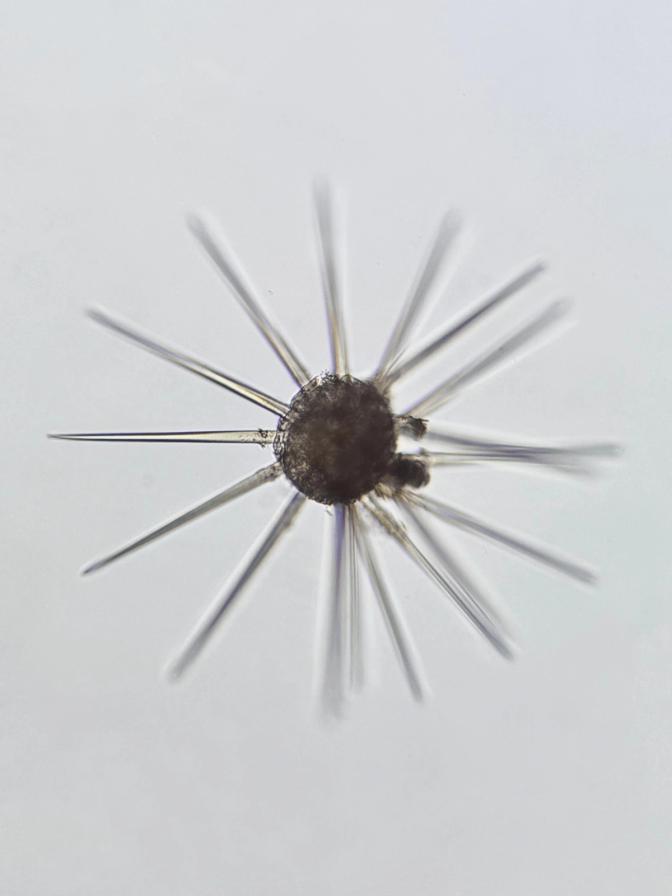
The cell itself is divided into inner (endoplasm) and outer (ectoplasm) layers, which are separated by a capsule wall. Inside the endoplasm are all the cell organelles, like multiple nuclei, mitochondria, and Golgi bodies. The ectoplasm is where the food is digested, and is encapsulated by the periplasmic cortex, which attaches to each spicule via myonemes, contracting fibres that aid in the buoyancy of the cell (Larnik & Westheide, 2011; Decelle & Not, 2015).
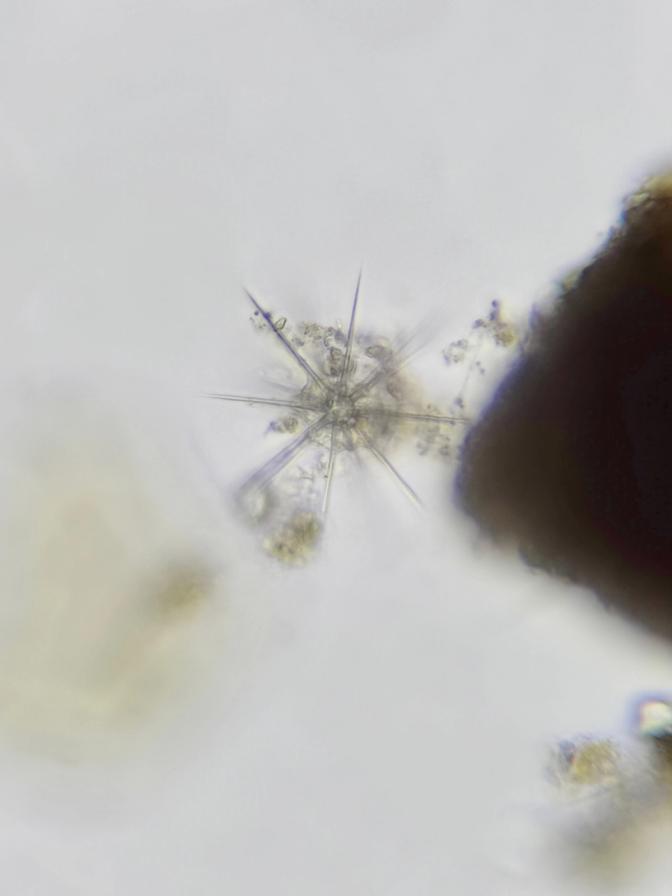
As Acantharia are heterotrophic (although some taxa do have symbiotic relationships with microalgae), they require a method of prey capture. They do this using their axopods, which are pseudopodia supported by microtubules that allow them to transport their meal to inside the cell for digestion. It seems that Acantharia are not fussy eaters, making use of whatever is available in the environment, such as bacteria, phytoplankton, other protists and animal larvae (Decelle & Not, 2015).
I’ve only ever come across 2 Acantharia cells over the years - one in a spring sample from Gorleston Pier and the other in an autumn sample from Cromer Pier. I’d love to see more of these beautiful little organisms, and if you need more convincing, do check out Ernst Haeckel’s beautiful illustrations of Radiolaria.